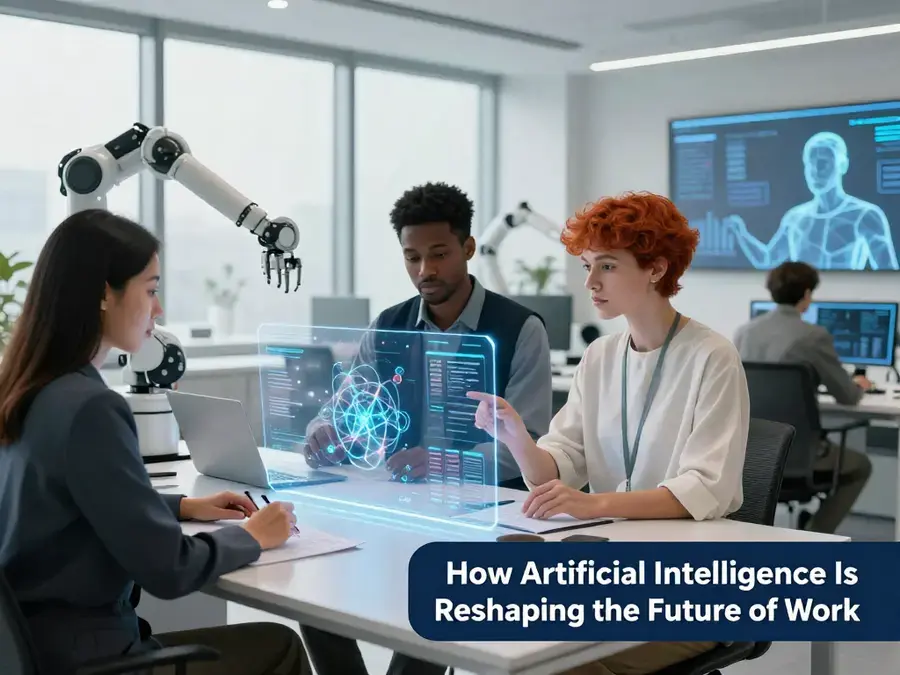

Artificial intelligence is transforming workplaces faster than most people realize. From chatbots handling customer service to algorithms screening job applications, AI tools are already changing how we work every day. Recent studies show that 85% of companies plan to adopt AI technologies within the next two years. This shift affects everyone from factory workers to CEOs. Some jobs will disappear, while entirely new careers will emerge. Many workers feel anxious about these changes. Will AI replace human employees? Which skills will matter most in an AI-driven world? How can professionals prepare for this transformation? This article examines how artificial intelligence is reshaping different industries and job roles. You’ll discover which positions face the highest risk of automation and which careers are growing because of AI. We’ll compare traditional work methods with AI-enhanced approaches across multiple sectors. You’ll also learn practical strategies for adapting to this new landscape. We cover essential skills that remain uniquely human and emerging opportunities that AI creates. Real workplace examples show how companies successfully integrate AI while supporting their employees. Whether you’re a recent graduate, mid-career professional, or business leader, understanding AI’s impact on work is crucial. The changes happening now will define career paths for decades to come. By the end of this article, you’ll have a clear roadmap for thriving in an AI-enhanced workplace. You’ll know which trends to watch and how to position yourself for success in the future of work.
🤖
📚 Table of Contents
H2: AI Technologies Currently Transforming Workplaces
Modern workplaces are experiencing rapid transformation through AI adoption. Companies across industries are implementing intelligent systems to streamline operations and boost productivity.
Machine Learning Platforms Reshaping Business Operations
Enterprise ML platforms like DataRobot and H2O.ai are automating complex data analysis tasks. These tools reduce model development time from months to weeks.
Financial institutions use these platforms for fraud detection and risk assessment. JPMorgan Chase processes millions of transactions daily using ML algorithms that flag suspicious activities in real-time.
- Automated feature engineering reduces manual coding by 80%
- Pre-built model templates accelerate deployment timelines
- Integration APIs connect seamlessly with existing business systems
- Model monitoring ensures consistent performance over time
Natural Language Processing Tools Revolutionizing Communication
OpenAI’s GPT models and Google’s BERT are transforming customer service operations. Companies integrate these technologies through APIs costing $0.002 per 1,000 tokens.
Customer support teams use NLP for ticket classification and response generation. Shopify reduced response times by 60% using automated email categorization systems.
Legal firms leverage document analysis tools like Kira Systems for contract review. These platforms identify key clauses and potential risks within minutes instead of hours.
Computer Vision Applications Enhancing Quality Control
Manufacturing companies deploy computer vision systems for defect detection and quality assurance. Cognex and Keyence cameras integrate with production lines seamlessly.
Automotive manufacturers achieve 99.5% accuracy in component inspection using these systems. Implementation costs range from $50,000 to $200,000 per production line.
- Real-time defect identification prevents costly recalls
- Automated sorting reduces manual labor requirements
- Predictive maintenance alerts prevent equipment failures
Robotic Process Automation Streamlining Repetitive Tasks
UiPath and Blue Prism lead the RPA market with user-friendly automation tools. These platforms require minimal coding knowledge for basic implementations.
HR departments automate employee onboarding processes using RPA bots. Companies report 70% time savings on administrative tasks after deployment.
H2: Jobs Being Created vs. Jobs Being Eliminated by AI
The AI revolution creates a fascinating paradox in today’s job market. While automation eliminates certain roles, it simultaneously generates entirely new career paths and opportunities.
New Job Categories Emerging from AI Growth
AI implementation has sparked demand for specialized roles that didn’t exist five years ago. Companies now actively recruit prompt engineers who craft effective instructions for large language models like GPT-4 and Claude.
Machine learning operations engineers manage AI model deployment and monitoring. Data scientists specializing in neural network architecture earn premium salaries at tech giants. AI ethics consultants help organizations navigate responsible AI development.
- AI trainers who teach models industry-specific knowledge
- Conversational AI designers for chatbot experiences
- Computer vision specialists for autonomous systems
- AI product managers bridging technical and business teams
Traditional Roles Being Displaced
Automation particularly impacts repetitive, rule-based positions across multiple industries. Data entry clerks face significant displacement as tools like UiPath and Automation Anywhere handle routine processing tasks.
Customer service representatives increasingly compete with sophisticated chatbots. Basic content writers struggle against AI writing tools like Jasper and Copy.ai. Manufacturing assembly workers see robots taking over standardized production lines.
Skills Transformation in Existing Jobs
Many roles evolve rather than disappear completely. Marketing professionals now use AI tools like HubSpot’s content assistant and Marketo’s predictive analytics. They focus more on strategy and creativity while AI handles data analysis.
Financial analysts leverage platforms like DataRobot for predictive modeling. Their work shifts toward interpreting AI insights and making strategic recommendations. Human judgment becomes more valuable as AI handles computational tasks.
Healthcare professionals use AI diagnostic tools but maintain critical decision-making authority. The human element remains irreplaceable in complex problem-solving and emotional intelligence scenarios.
H2: Essential Skills Workers Need to Stay Competitive
The AI revolution demands workers adapt quickly or risk obsolescence. Smart professionals are already building skills that complement machine intelligence rather than compete with it.
Technical Literacy Beyond Basic Computer Skills
Modern workers need hands-on experience with AI platforms like ChatGPT, Claude, and Midjourney. Understanding prompt engineering can boost productivity by 40% across most knowledge work roles.
Data literacy has become non-negotiable. Workers should grasp basic concepts like training data, model accuracy, and algorithmic bias. Even marketing professionals now use tools like Jasper AI and Copy.ai daily.
- Python basics for data manipulation and automation
- SQL proficiency for database queries and analysis
- API integration to connect different AI tools
- No-code platforms like Zapier and Make for workflow automation
Critical Thinking and AI Collaboration
The most valuable skill is knowing when AI helps and when it hurts. Top performers learn to fact-check AI outputs and identify potential hallucinations or errors.
Successful professionals treat AI as a research assistant, not a replacement for judgment. They use tools like Perplexity AI for initial research, then apply human insight for strategic decisions.
Emotional Intelligence and Human-Centered Skills
AI cannot replicate genuine empathy, creative problem-solving, or complex relationship management. These skills become more valuable as routine tasks get automated.
Customer service representatives using AI chatbots still need strong communication skills. The technology handles basic queries, but humans manage escalations and build trust.
- Active listening for understanding nuanced client needs
- Conflict resolution in human-AI collaborative environments
- Creative storytelling that resonates emotionally
Continuous Learning and Adaptation
AI tools evolve monthly, not yearly. Workers must embrace lifelong learning through platforms like Coursera, Udacity, and company-specific training programs.
The most successful professionals dedicate 30 minutes daily to experimenting with new AI features. They join communities like Reddit’s r/ChatGPT and follow AI newsletters for updates.
H2: How Different Industries Are Adapting to AI Integration
Companies across every sector are racing to implement AI solutions. The transformation is happening faster than most executives anticipated.
Healthcare’s AI Revolution
Hospitals are deploying diagnostic AI systems like PathAI for cancer detection. These tools reduce diagnosis time from weeks to hours. Radiology departments use Zebra Medical Vision to spot fractures and tumors automatically.
Electronic health records now integrate with IBM Watson Health. Doctors get real-time treatment recommendations based on patient data. Cleveland Clinic reports 30% faster diagnosis rates since implementing AI workflows.
Financial Services Leading the Charge
Banks use fraud detection algorithms that process millions of transactions daily. JPMorgan Chase’s COIN system reviews legal documents in seconds instead of hours. Credit scoring models now analyze 500+ data points for loan approvals.
Robo-advisors like Betterment manage $30 billion in assets using AI. Trading firms deploy machine learning for high-frequency trading strategies. Goldman Sachs replaced 600 traders with 200 engineers running automated systems.
Manufacturing’s Smart Factory Evolution
Production lines use predictive maintenance to prevent equipment failures. General Electric saves $1.2 billion annually through AI-powered turbine monitoring. Quality control cameras spot defects faster than human inspectors.
Supply chain optimization reduces inventory costs by 25%. Siemens factories use digital twins to simulate production changes. Tesla’s Gigafactory relies on AI for battery cell quality testing.
Retail’s Personalization Push
E-commerce platforms analyze browsing patterns to recommend products. Amazon’s recommendation engine drives 35% of total sales. Dynamic pricing algorithms adjust costs based on demand and competition.
Physical stores use computer vision for inventory tracking. Walmart deploys shelf-scanning robots in 1,000+ locations. Customer service chatbots handle 80% of routine inquiries without human intervention.
H2: Preparing Your Career for an AI-Driven Future
The AI revolution isn’t coming tomorrow—it’s happening right now. Smart professionals are already adapting their skills to stay competitive in this rapidly changing landscape.
Essential Skills That AI Can’t Replace
Focus on developing uniquely human capabilities that complement AI tools. Creative problem-solving remains irreplaceable, especially when dealing with complex business challenges.
Emotional intelligence becomes more valuable as AI handles routine tasks. Companies like Salesforce report that roles requiring human empathy and relationship-building have grown 40% since 2020.
- Strategic thinking and decision-making under uncertainty
- Cross-functional collaboration and team leadership
- Ethical reasoning and bias detection in AI systems
- Customer relationship management and negotiation
Building AI Literacy in Your Current Role
Start by identifying AI tools relevant to your industry. Marketing professionals might explore Jasper AI for content creation or Drift for chatbot implementation.
Take on pilot projects using platforms like DataRobot or H2O.ai. Even small experiments help you understand AI capabilities and limitations firsthand.
Many companies offer internal AI training programs. Amazon’s Machine Learning University and Google’s AI Education initiative provide free resources for employees across industries.
Strategic Career Positioning
Position yourself as an AI-human bridge within your organization. This means understanding both technical possibilities and business requirements.
Consider roles like AI Product Manager, Machine Learning Operations Engineer, or AI Ethics Specialist. These positions combine domain expertise with AI knowledge.
- Pursue certifications from AWS, Microsoft Azure, or Google Cloud
- Join AI-focused professional communities and attend industry conferences
- Develop expertise in AI governance and compliance frameworks
- Build a portfolio showcasing successful AI implementation projects
The key is becoming someone who can translate between AI capabilities and real-world business needs.
Conclusion
Artificial intelligence is reshaping the American workforce at an unprecedented pace. The technology is eliminating some traditional roles while creating entirely new career opportunities. Workers who adapt and learn essential AI skills will thrive in this changing landscape. The key to success lies in understanding that AI is a tool, not a replacement for human creativity and problem-solving. Industries across the United States are finding ways to blend human expertise with artificial intelligence capabilities. This partnership approach creates more efficient workflows and opens doors to innovative job roles. The most important step you can take is to start learning now. Develop digital literacy skills and stay curious about emerging technologies. Focus on skills that complement AI rather than compete with it. Critical thinking, emotional intelligence, and creative problem-solving remain uniquely human strengths. The future workplace will reward those who embrace change and continuous learning. Companies need workers who can bridge the gap between human insight and AI efficiency. By preparing yourself today, you position yourself for the exciting opportunities that lie ahead. The AI revolution is not something happening to you—it is something you can actively shape and benefit from.